|
Chemicals
 Para Anisyl Choride
Para Anisyl Choride
CAS Registry Number: 105-13-5
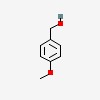
IUPAC name :(4-methoxyphenyl)methanol InChI :InChI=1/C8H10O2/c1-10-8-4-2-7(6-9)3-5-8/h2-5,9H,6H2,1H3
InChIKey :MSHFRERJPWKJFX-UHFFFAOYAE SMILES :COC1=CC=C(C=C1)CO
| Cas Number : |
105-13-5 |
| (EINECS) number : |
203-273-6 |
| beilstein number : |
0636654 |
| fema number : |
2099 |
| coe number : |
66 |
| jecfa number : |
871 |
| fl. number : |
02.128 |
| molar refractivity : |
39.38 ± 0.3 cm3 |
| parachor : |
317.4 ± 4.0 cm3 |
| index of refraction : |
1.531 ± 0.02 |
| surface tension : |
38.7 ± 3.0 dyne/cm |
| density : |
1.085 ± 0.06 g/cm3 |
| polarizability : |
15.61 ± 0.5 10-24cm3 |
| xlogp : |
1.10 |
| molecular weight : |
138.1638000 |
| formula : |
C8 H10 O2 |
| BioActivity Analysis : |
68837 |
properties :
appearence : white to pale yellow liquid to solid
assay : 98.00 to 100.00 %
Food Chemicals Codex Listed : Yes
specific gravity : 1.10800 to 1.11600 @ 25.00 °C.
pounds per gallon - calc. : 9.220 to 9.286
specific gravity : 1.10900 to 1.11700 @ 20.00 °C.
pounds per gallon - calc. : 9.239 to 9.305
refractive index : 1.54200 to 1.54600 @ 20.00 °C.
melting point : 23.00 to 25.00 °C. @ 760.00 mm Hg
boiling point : 259.00 to 260.00 °C. @ 760.00 mm Hg
congealing point : 24.00 °C.
acid value : 1.00 max. KOH/g
vapor pressure : 0.00380 mm/Hg @ 25.00 °C.
flash point : 230.00 °F. TCC ( 110.00 °C. )
logp : 1.10
shelf life : 24.00 month(s) or longer if stored properly.
storage : store in cool, dry place in tightly sealed
containers, protected from heat and light.
safety :
most important hazard(s) : Xn - Harmful.
R 22 - Harmful if swallowed.
R 36/37/38 - Irritating to eyes, respiratory system, and skin.
R 41 - Risk of serious damage to eyes.
R 43 - May cause sensitisation by skin contact.
S 02 - Keep out of the reach of children.
S 26 - In case of contact with eyes, rinse immediately with plenty
of water and seek medical advice.
S 39 - Wear eye/face protection.
Oral Toxicity(LD50) :
Oral-Rat 1200.00 ul/kg
JPETAB 93,26,1948
Oral-Mouse 1600.00 ul/kg
Oral-Mouse 1780.00 mg/kg
(Draize et al., 1948)
Oral-Rat 1340.00 mg/kg
(Draize et al., 1948)
Dermal Toxicity(LD50) :
Skin-Rabbit 3000.00 mg/kg
FCTXAV 12,825,1974
Skin-Mouse >10.00
Inhalation Toxicity(LC50) :
Not determined
safety in use :
Maximised Survey-derived Daily Intakes (MSDI-EU) : 130.00 (μg/capita/day)
Maximised Survey-derived Daily Intakes (MSDI-USA) : 58.00 (μg/capita/day)
IFRA critical Effect : Sensitization
| |
|
Note /Government
Notification: These chemicals are designated as those that are
used in the manufacture of the controlled substances and are
important to the manufacture of the substances. For any (Control
Substance) products Import and Export *** subjected to your
country government laws /control substance ACT.
Information: The information on this web page is provided to
help you to work safely, but it is intended to be an overview of
hazards, not a replacement for a full Material Safety Data Sheet
(MSDS). MSDS forms can be downloaded from the web sites of many
chemical suppliers. ,also that the information on the PTCL
Safety web site, where this page was hosted, has been copied
onto many other sites, often without permission. If you have any
doubts about the veracity of the information that you are
viewing, or have any queries, please check the URL that your web
browser displays for this page. If the URL begins "www.tajapi.com/www/Denatonium
Benzoate.htm/" the page is maintained by the Safety Officer in
Physical Chemistry at Oxford University. If not, this page is a
copy made by some other person and we have no responsibility for
it.
The Controlled Substances Act (CSA) was enacted into law by the
Congress of the United States as Title II of the Comprehensive
Drug Abuse Prevention and Control Act of 1970.[1] The CSA is the
federal U.S. drug policy under which the manufacture,
importation, possession, use and distribution of certain
substances is regulated. The Act also served as the national
implementing legislation for the Single Convention on Narcotic
Drugs |
 |




 India
India
 ©
2004 - 2019
Taj Pharmaceuticals Limited
. All rights reserved
©
2004 - 2019
Taj Pharmaceuticals Limited
. All rights reserved